For medical devices and pharmaceutical manufacturers, packaging is not just a protective layer—it is a critical component of product integrity, patient safety, and regulatory compliance. Transportation stresses such as vibration, compression, and impacts can compromise product quality long before it reaches the end user.
As part of its strategic growth plan, ECI,a consuting company, decided to open a new in-house laboratory in Costa Rica. The objective was clear: to gain full control over packaging validation and transportation simulation testing, ensuring that products remain protected throughout the distribution chain.
Rather than relying on external laboratories, ECI wanted a dedicated testing facility that could support internal development, quality assurance, and continuous improvement— ligned with international standards and good manufacturing best practices.
Launching a new laboratory from scratch presents multiple challenges:
- Selecting the right testing equipment to cover real transportation risks.
- Ensuring compliance with ASTM, ISO, and ISTA standards.
- Designing a testing environment that is reliable, repeatable, and scalable.
- Training internal teams to operate the equipment independently and efficiently.
ECI needed more than individual machines. They required a coherent, end-to-end transportation simulation solution that could support their packaging strategy both today and in the future.
Why in-house packaging and transportation testing matters for life sciences manufacturers
For life sciences manufacturers, packaging and transportation testing is not just a technical requirement, it is a critical component of product quality, patient safety, and regulatory compliance.
During distribution, medical devices, pharmaceutical products, and other sensitive goods are exposed to vibration, compression, impact, altitude, and environmental stress. If these risks are not properly evaluated, packaging failures can occur late in the supply chain, where the cost and impact are highest.
That’s where ECI’s Distribution & Stability Testing Laboratory plays a strategic role.
By providing local, independent testing aligned with international standards, ECI helps manufacturers:
- Validate packaging performance under real-world distribution conditions
- Reduce reliance on overseas testing and long lead times
- Identify risks early in development and scale-up
- Support regulatory submissions with defensible data
- Accelerate time to market without compromising quality
At ECI, packaging testing is not performed in isolation. It is integrated into a broader lifecycle approach that connects design, validation, quality, regulatory expectations, and supply chain realities.
Our laboratory exists to help life sciences companies bring products to market with confidence, knowing that packaging will protect product integrity from production to patient.
A complete transportation simulation center
Safe Load Testing Technologies supported ECI by supplying three key testing systems, selected to work together within the new laboratory environment
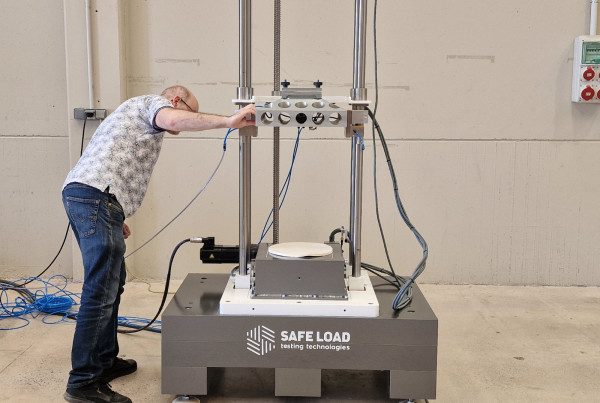
Vertical vibration tester
The vertical vibration testing system reproduces the vibrations that packaging and products experience during transportation. It applies controlled vertical motion to simulate road, rail, and air transportation conditions using standardized or custom vibration profiles, allowing packaging performance to be evaluated under realistic and repeatable laboratory conditions.
In regulated product distribution, even minor packaging failures can compromise product quality, stability, or patient safety. By reproducing transportation-related vibration in a controlled environment, this system enables early identification of risks such as product movement, abrasion, loss of package integrity, or closure failure. The resulting data supports packaging validation activities, facilitates compliance with recognized testing standards, and strengthens quality assurance by providing objective evidence of packaging performance throughout the distribution process.

Compression Tester
The compression tester applies controlled vertical and lateral compressive loads to quality-critical packaging to evaluate how it performs under stacking, storage, and transportation stresses. By measuring deformation and resistance under specified loads, the system quantifies how packaging structures respond to real-world conditions such as pallet stacking, shelf storage, and handling loads encountered throughout the distribution chain.
Quality-sensitive products are often stacked, stored, and transported under variable load conditions. If the packaging does not provide sufficient compression strength, it may deform, lose stability, or compromise closures, potentially affecting product quality and regulatory compliance.
Controlled compression testing allows manufacturers to verify that packaging maintains its structural integrity under expected storage and transportation loads. It provides quantitative data to support packaging design decisions, material selection, and validation activities, while generating objective evidence aligned with recognized standards. By identifying potential failure modes early, compression testing helps reduce distribution risks and supports consistent product protection from production through final delivery.

Drop Tester
The drop tester is used to evaluate how packaging and products respond to handling-related impacts during transportation and distribution. It performs controlled free-fall drop tests from defined heights to simulate real-world events such as drops during loading, unloading, picking, or manual handling. By testing flat, edge, corner, and rotational drops, the system allows manufacturers to assess the packaging’s ability to absorb shock and protect the product under repeatable laboratory conditions.
In regulated distribution environments, even low-height drops can compromise packaging integrity, closures, or protective components, potentially affecting product quality and safety. Drop testing enables manufacturers of sensitive goods to identify impact-related risks early, verify that packaging provides adequate protection during handling, and generate objective data to support packaging validation activities. By reproducing realistic handling impacts in a controlled environment, the drop tester helps reduce distribution-related failures and reinforces quality assurance across the supply chain.

Together, these three systems form a balanced and practical testing setup focused on the most relevant transportation hazards, enabling a comprehensive and repeatable evaluation of packaging performance under realistic distribution conditions.
From planning to performance: A amooth implementation journey
Safe Load Testing Technologies delivered the project through a structured implementation process that included technical coordination to ensure proper integration of the equipment within the new laboratory, manufacturing and delivery of the testing systems, on-site installation at ECI’s facility in Costa Rica, and training and technology transfer to enable ECI’s technical team to operate the equipment and perform internal tests with confidence. This approach ensured that the laboratory became operational quickly and efficiently.

With the new laboratory fully equipped and operational, ECI achieved several tangible benefits:
- The ability to perform packaging testing internally, supporting product development and quality assurance activities.
- A deeper understanding of how packaging systems respond to realistic transportation-related stresses.
- Compliance with internationally recognized testing standards commonly applied in regulated distribution environments.
- Reduced dependence on external laboratories for routine packaging evaluation and verification.
The laboratory now functions as both an operational and strategic asset, enabling informed decision-making throughout packaging design, optimization, and validation processes.
This project illustrates how manufacturers operating in regulated and quality-sensitive sectors can successfully implement an in-house testing laboratory by prioritizing essential testing capabilities, rather than investing in unnecessary complexity or overspecification.
By delivering three complementary testing systems and supporting their integration, Safe Load Testing Technologies enabled ECI to establish a reliable, standards-aligned packaging testing laboratory designed to address current operational needs while remaining adaptable to future requirements.
For organizations seeking greater control over packaging performance and distribution risk management, this success story highlights the value of a focused, equipment-driven approach to internal testing.
Design your laboratory around real transportation risks.
Equip your team with reliable testing systems to evaluate vibration, compression, and impacts under controlled conditions.
Let’s talk about your testing requirements.